9 best places to see the Milky Way around Australia

hero media
Few things in this universe are more breathtaking than the Milky Way, and there are few better countries to gaze at it from than Australia.

There is nothing quite like leaving the city lights behind and swapping them for the twinkling lights of the Milky Way. The most wonderous expression I’ve ever seen on a face was on that of my boyfriend – a born and bred Rio local – who had never seen the stars outside of human light pollution before our road trip to Mungo National Park. I had warned him he would be blown away by the night sky, and he simply didn’t believe me. Until I made him get out of the tent at 1 am and take a look up.

The Milky Way in particular forms a fascinating and beautiful blanket splashed across the dark sky around Australia. For Astronomers, this spiral galaxy has provided a gives us a closer view of galaxy structure and content than any others, simply because we’re a part of it. For many Indigenous people, the Milky Way is associated with a river in the sky where the ancestor spirits live.

Spend a night soaking in its wonder at these places around Australia.

1. East MacDonnell Ranges, NT

The best views of the night sky come when you leave all man-made lights behind. That’s why heading into Central Australia is always a good idea for gazing at the Milky Way. Get a close-up look by heading to Earth Sanctuary, just outside Alice Springs. This award-winning, carbon-neutral outback venue overlooks the dramatic landscape of the East MacDonnell Ranges and offers Astro tours. With an experienced guide,  look through telescopes to spot planets, constellations and unearthly phenomena like dark nebulae.

Earth Sanctuary, East MacDonnell Ranges, Northern territory
See the sky close-up at Earth Sanctuary. (Image: Tourism NT/Matt Glastonbury)

2. Lincoln National Park, SA

Who says you have to be in the outback to see a clear night sky? Although remote and free of light pollution, Lincoln National Park is a place of stunning beaches and bays on the south-eastern tip of the Eyre Peninsula. Plenty of secluded campsites allow you to spend a night (or more) immersed in nature. Spend your days swimming and surfing, then lay out under the Milky Way, star clusters and nebula. All clear and crisp once the sun drops.

milky way above the Eyre Peninsula south australia
See the clearest of night skies around the Eyre Peninsula. (Tour South)

Need tips, more detail or itinerary ideas tailored to you? Ask AT.

AI Prompt

3. Warrumbungle National Park, NSW

Warrumbungle National Park owns the title of Australia’s first Dark Sky Park, thanks to its remote location and perfect climate of high altitude and low humidity. It’s impossible to miss the Milky Way even with bare eyes, but get a really good look by booking a ticket with Coonabarabran Star Gazing to see Siding Spring Observatory at the edge of the park. It’s here you’ll find the largest optical telescopes in Australia. Make the most of it by booking a camping spot, most of which include picnic tables, barbecue facilities, showers and toilets.

camping under the milky way in Warrumbungle National Park, NSW
Sleep in Australia’s first Dark Sky Park. (Image: Destination NSW)

4. Charleville, Qld

Head into Queensland’s outback to leave the big city lights behind, but also to gain a different insight into the Milky Way and surrounding stars. Charleville’s Cosmos Centre has a range of star-gazing tours, with the Universal Dreaming tour providing a particularly standout experience. Discover some of the ways many different ancient cultures connected with the night sky as you sit around a fire pit (you’ll even get to toast marshmallows while you listen). You’ll need to book ahead for this as it’s only upon request.

Charleville's Cosmos Centre
Book a star-gazing tour at Charleville’s Cosmos Centre. (Image: TEQ)

5. Kati Thanda-Lake Eyre National Park, SA

Typically, you might expect to head up as high as possible to catch a clear glimpse of the night sky. But, in fact, being Australia’s lowest point – up to 15 metres below sea level – makes Kati Thanda-Lake Eyre National Park one of the darkest areas in Australia. This means that star-gazing is at an optimum, but also that the Milky Way can be found reflecting on the water’s surface whenever the elusive lake is full. Stay the night in one of several classic outback hotels, or bring the tent and set up in Halligan Bay Point Campground for bush camping, or Muloorina Station to enjoy toilets and some facilities.

Aerial view over Kati Thanda-Lake Eyre National Park
The only thing better than gazing down at Kati Thanda-Lake Eyre National Park, is looking up from it at night. (Image: Greg Snell)

6. The Dish, NSW

If you somehow missed the classic Aussie movie The Dish back in 2000, I strongly recommend you watch it before you arrive. It’s a fun way to learn the true story of how this CSIRO Parkes Radio Telescope played an important part in communicating with the Apollo 11 mission. Located in Goobang National Park, part of its charm is due to seemingly being in the middle of nowhere – a great sign for stargazing and spotting the Milky Way. You’ll find free campgrounds here, and it’s recommended to visit in autumn when the night sky is typically clearest.

CSIRO Parkes Radio Telescope at dusk
See the famous Dish up close, then stay for the stars. (Image: Destination NSW)

Weekly travel news, experiences
insider tips, offers, and more.

7. Uluṟu-Kata Tjuṯa National Park, NT

Few things could be more iconically Australian than seeing Uluru at night, framed by the Milky Way. In fact, settling into one of several vantage points along walking trails in the park from sunset means you’ll watch the rock and sky transform their colours through purple and orange hues as the sun drops to reveal all the starry twinkles of the universe. With little to no light pollution, the stars come out in full force. Every night is different – you may even see the rings of Saturn or a shooting star. There are a few tour options to help you see even better, including Uluru Astro Tour.

uluru under the milky way
See the stars in full force. (Image: Tourism NT/New Asia Pacific Travel)

8. Gravity Discovery Centre Observatory, WA

It’s pretty safe to say that all observatories in Australia are good places to start if you want to catch the Milky Way up close. Gravity Discovery Centre Observatory in Gingin allows members of the public to use its state-of-the-art technology every Friday and Saturday night. There are a few guided tour options, including lecture-style tours about fascinating parts of the universe and Aboriginal Astronomy. The latter partners with Indigenous Tours to showcase the connection between cultural storytelling and Astronomy.

Gravity Discovery Centre Observatory, WA
Use state-of-the-art technology at Gravity Discovery Centre Observatory. (Image: Tourism WA)

9. Karlu Karlu Reserve, NT

One of the outback’s more unique sights is the stacked, round boulders known as Karlu Karlu / The Devil’s Marbles. They cut a pretty impressive figure at any time of day, but silhouetted against a blazing Milky Way is particularly spectacular. This remote red desert has plenty of campsites so you can spend all night staring skywards. If you haven’t quite had your fill of the universe, you can also drive an extra hour to Wycliffe, known as the UFO capital of Australia. Cue X-Files music.

Devils Marbles / karlu karlu at night
See Karlu Karlu against the stars. (Image: Tourism NT/Sean Scott)
Can’t get enough of the night skies? Discover the best spots around Australia for stargazing.

Want to see more stories from Australian Traveller in your Google search results?

  1. Click here to set Australian Traveller as a preferred source.
  2. Tick the box next to "Australian Traveller". That's it.
Kassia Byrnes
Kassia Byrnes is the Native Content Editor for Australian Traveller and International Traveller. She's come a long way since writing in her diary about family trips to Grandma's. After graduating a BA of Communication from University of Technology Sydney, she has been writing about her travels (and more) professionally for over 10 years for titles like AWOL, News.com.au, Pedestrian.TV, Body + Soul and Punkee. She's addicted to travel but has a terrible sense of direction, so you can usually find her getting lost somewhere new around the world. Luckily, she loves to explore and have new adventures – whether that’s exploring the backstreets, bungee jumping off a bridge or hiking for days. You can follow her adventures on Instagram @probably_kassia.
View profile and articles
hero media

6 reasons the best way to experience the Kimberley is by cruise

    Kate Bettes Kate Bettes
    This remote corner of Australia is one of the world’s last frontiers. This is how to see it properly.

    Vast, rugged and deeply spiritual, the Kimberley coast in Australia’s North West feels a world away from everyday Australia – and there are countless ways to explore it. But if you want to reach ancient rock art, hidden gorges and lonely waterfalls, it has to be by boat. Whether you’re aboard a nimble expedition vessel or a luxury yacht with all the trimmings, exploring by the water brings exclusive experiences, shows unique views and makes travel easier than any other mode. And that’s just the beginning of Australia’s North West cruises.

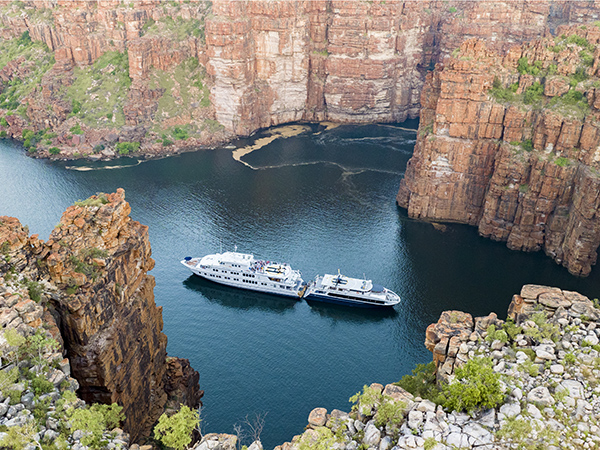
    The True North Adventure Cruise in between sandstone cliffs.
    Adventure starts where the road ends.

    1. Discover Broome, and beyond

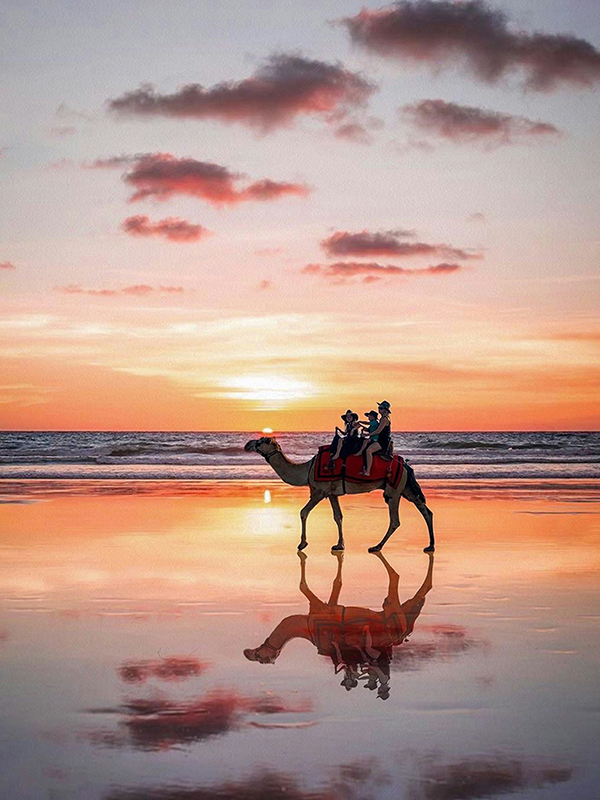
    Explore your launchpad before you set sail: Broome. Here camels and their riders stride along the 22 kilometres of powdery Cable Beach at sunset. That’s just the start.

    At Gantheaume Point, red pindan cliffs plunge into the turquoise sea, whose low tide uncovers fossilised dinosaur footprints. Broome’s pearling history runs deep. Japanese, Chinese, Malay and Aboriginal divers once worked these waters, and their legacy lives on in boutiques where South Sea pearls still shine.

    If the moon’s right, you may catch the Staircase to the Moon over Roebuck Bay. Or simply kick back with a cold beverage and a film under the stars at Sun Pictures, screening since 1916.

    Ride a camel along Cable Beach as the sun sinks into the Indian Ocean, casting golden light across the sand and sea.
    Ride a camel along Cable Beach. (Image: Nick Dunn)

    2. Unmatched access to The Kimberley

    Once you’re onboard, expect a backstage pass to some of the most isolated places on Earth. No roads. No ports. No phone reception.

    At Horizontal Falls/ Garaanngaddim, 10-metre tides surge through twin gorges like a natural waterpark ride that’ll make your palms sweat. Then there’s Montgomery Reef/ Yowjab: a giant living platform of coral and seagrass, where the sea pulls back to reveal waterfalls, sea turtles and ospreys.

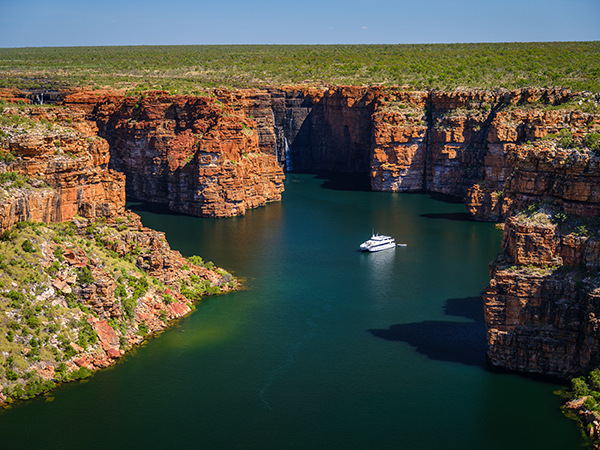
    Up north, King George Falls/ Oomari rage 80 metres down red cliffs. Zodiac boats often nudge in closer so you can feel the spray on your sun-warmed cheeks. You might even fly in to reach Mitchell Falls/ Punamii-unpuu, a four-tiered cascade where you can swim in freshwater pools above the drop.

    Come spring, some itineraries veer west to Rowley Shoals: an atoll chain of white sand and reef walls. Then it’s up the winding Prince Regent River to King Cascade/ Maamboolbadda, tumbling over rock terraces, and into a Zodiac to view the Gwion Gwion rock art, whose slender, ochre-painted figures are older than the pyramids.

    A cruise drifts beneath King George Falls, where sheer sandstone cliffs frame the thunderous plunge into turquoise waters.
    Get closer to the Kimberley than ever before.

    3. Taste the Kimberley with onboard hospitality

    You might spend your days clambering over slippery rocks or charging past waterfalls. But when you’re back on the water, it’s a different story. Meals are chef-prepared and regionally inspired: grilled barramundi, pearl meat sashimi, mango tarts, and bush tomato chutney. One night it’s barefoot beach barbecues with your shipmates; the next, alfresco dining on the ship.

    Small expedition ships each have their own personality, but many carry just 12 to 36 guests, making being out on the water a whole other experience. You might sink into a spa on the foredeck or sip coffee in a lounge while watching crocodiles cruise by. It’s choose-your-own-relaxation, Kimberley style.

    4. Expert-led excursions through the Kimberley

    These voyages are led by people who know the Kimberley like the back of their sunburnt hand. Attenborough-esque naturalists might gently tap your shoulder to point out rare birds or tell the story beneath a slab of rock. Historians can explain exactly how that rusted World War II relic came to rest here.

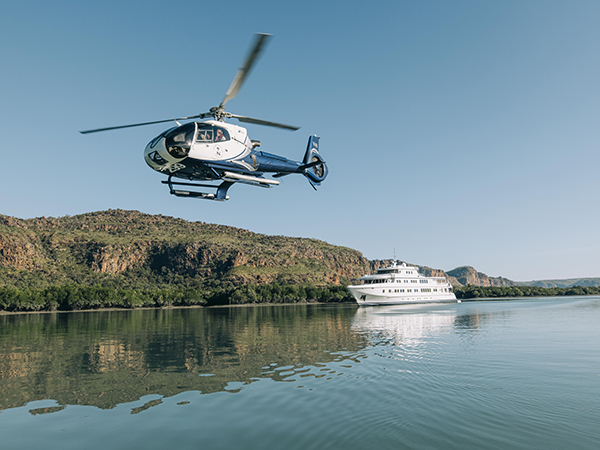
    If your ship has a helipad, you might chopper straight to a waterfall-fed swimming hole. If not, you’ll still be hopping ashore for that wet landing at a secret creek.

    Then come the evenings: songlines shared by Traditional Owners under the stars, or astronomy sessions that link what’s overhead with what’s underfoot and what’s within.

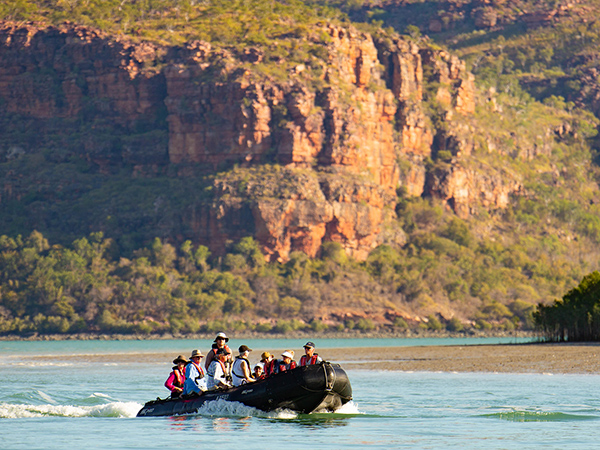
    A small group glides through Kimberley’s rugged coastline by boat, passing ancient cliffs.
    Explore with naturalists and historians by your side.

    5. Relax in luxurious lodgings

    Just because you’re off-grid doesn’t mean you have to rough it. These Kimberley vessels are small in size, but mighty in luxury. True North’s ships come with their own helicopters and a no-sea-days policy, so you’re always in the thick of it. Try the luxurious offerings from Ocean Dream Charters for exploration in style. Kimberley Quest offers a fast boat for easy, off-ship adventures. On the larger end of the scale, Coral Expeditions has open-deck bars and curated wine cellars. And then there’s Ponant’s luxury yachts – sleek and incredibly stylish French sailing yachts.

    A helicopter soars above the sea, with a sleek cruise ship gliding in the distance.
    See the Kimberley from sky to shore.

    6. The adventure continues with pre- and post-cruise experiences

    You’ve already come this far – so, why not go further? Broome makes it easy to ease in before you board, or wind down when your voyage ends, and there is no reason to stop there.

    Head an hour and a half south to Eco Beach to stay off-grid and off the clock. Join a Yawuru guide for a mangrove walk or ocean forage. Dive even deeper into Broome’s pearling past at Willie Creek or Cygnet Bay, where divers and craftspeople still pull the seawater-slicked gems from the deep.

    If you’re still craving adventure, it’s time to go further. Soar over the Buccaneer Archipelago, or detour inland with a 4WD trip along the Gibb River Road. Book a scenic flight over the Bungle Bungles. Or – because you never know when you’ll be back – do all three.

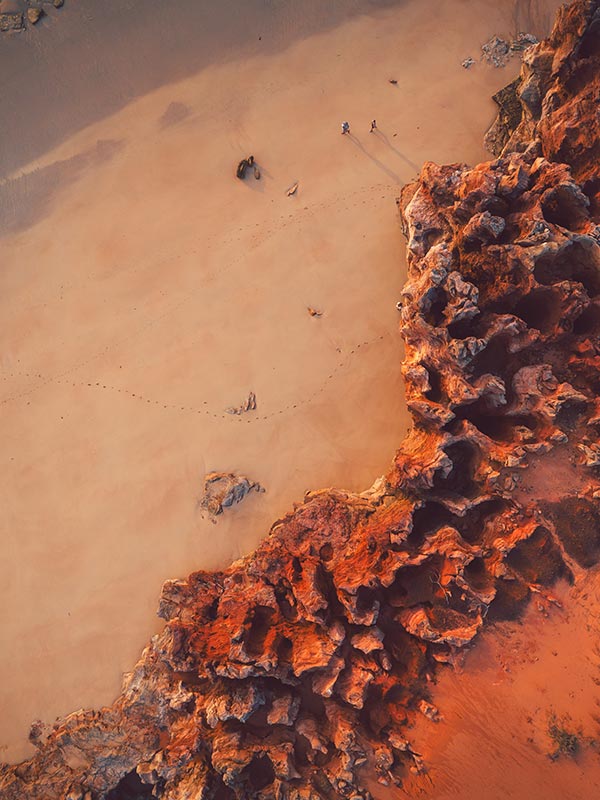
    aerial of people walking on eco beach in the kimberley western australia
    Stay off grid at Eco Beach. (Image: Tourism WA)

    Find out more about your trip to Australia’s North West at australiasnorthwest.com.

    9 best places to see the Milky Way around Australia