Meteors, supermoons, a comet: a guide to the southern sky in 2024

hero media
What exciting events will we see in the southern sky in 2024? Meteor showers, Saturn covered by the Moon, close approaches of bright planets to each other, supermoons – and, if we’re lucky, a comet visible to the naked eye.

Even if you live in a city surrounded by light pollution, these are all worth looking out for. Here are some of the highlights.

May – the Eta Aquarid meteors

The first of the two main Southern Hemisphere meteor showers during the year is the Eta Aquariid or Eta Aquarid shower. It’s named after a star in the constellation of Aquarius, the Water Carrier, as the meteors appear to originate from there.

Meteors are small particles hitting Earth’s atmosphere and creating a streak of light as they burn up. A meteor shower occurs when many particles hit, all coming from the same direction.

They are generally due to Earth passing through a stream of dust left behind by a comet. For the Eta Aquariids, the comet is the famous Halley’s Comet, which was first recorded more than 2,000 years ago.

In 2024, there will be a good opportunity to see them in the early mornings of Monday 6 and Tuesday 7 May, as the Moon will not be brightening the sky.

December – the Geminid meteors

The second of the two main meteor showers is the Geminid shower. This originates in the direction of the constellation of Gemini, the Twins.

Unusually, they are associated not with a comet but with a rocky asteroid named Phaeton. In 2024, they are likely to be best seen early on the morning of Saturday 14 December.

The peak time to view is during the short interval between the setting of the Moon and the start of dawn.

Need tips, more detail or itinerary ideas tailored to you? Ask AT.

AI Prompt

March, June and August – the planets

Celestial objects approaching one another in the sky can provide a nice view. On the evening of Friday 22 March, the brightest planet Venus is less than the width of the Moon away from the ringed planet Saturn. Look low down in the east.

For people in the eastern part of Australia, the Moon covers the planet Saturn low in the eastern sky on the night of Thursday 27 June. The event can be seen by eye, but binoculars or a small telescope would help.

It is safe to take images or video. From Sydney, Saturn disappears at the bright edge of the Moon at 10:55pm and reappears at its dark edge at 11:41pm. The times for Brisbane, Canberra and Melbourne are similar.
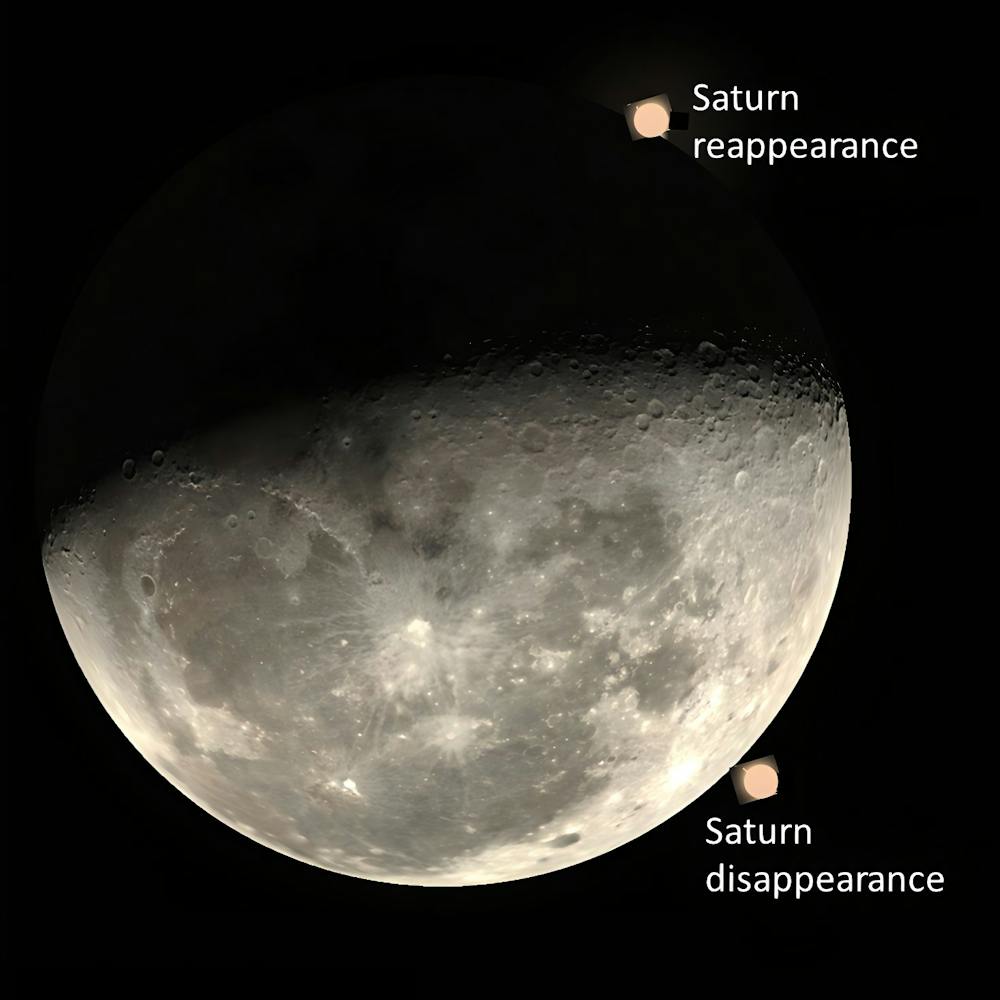
Diagram showing Saturn disappearing behind the Moon and later reappearing.

The occultation or covering of Saturn on Thursday 27 June 2024. (Image: Nick Lomb / Stellarium)

Another close approach is in the early morning of Thursday 15 August, when the red planet Mars is less than a Moon-width from the giant planet Jupiter.

September and October – supermoons

There will be two supermoons during 2024. The Moon has a path that sometimes takes it further from Earth and sometimes closer.

Recently, a time when the full Moon coincides with the Moon at its closest point to Earth has become known as a supermoon. At this time the Moon is slightly larger in the sky than usual.

It’s best to look at moonrise, as an illusion in our brains makes the Moon appear larger when it’s near the horizon. The supermoons in 2024 are on Wednesday 18 September and Thursday 17 October.

October – Comet C/2023 A3 (Tsuchinshan-ATLAS)

Comets visible to the naked eye are rare and exciting events. A comet with the impressive name of Comet C/2023 A3 (Tsuchinshan-ATLAS), discovered in January 2023, is approaching the Sun and Earth, and may become bright enough to be easily seen. As yet, it is unknown whether this will happen – comets are notoriously fickle.

At a distance of 71 million kilometres, the comet will be closest to Earth on Sunday 13 October. However, for the next six days a bright Moon will make sighting it unlikely.

By Saturday 19 October, the Moon will have moved out of the way. That evening and the following few evenings will give us the best chance to see it. Look low in the west.

January and May – constellations

Not only these highlighted events can be seen in the sky. There are star pictures or constellations that still stand out in the sky of bright cities.

Orion, the Hunter, is a favourite Southern Hemisphere summer constellation, high in the northern sky on January evenings. It consists of four bright stars in a rectangle with a line of three stars, representing Orion’s belt, in the middle.
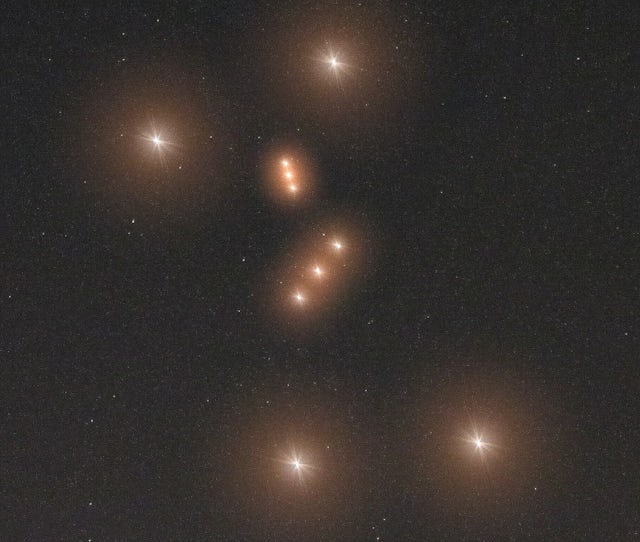
A photo of the constellation Orion.

The constellation Orion is named for a hunter from Greek myth. (Image: Nick Lomb)

According to Greek legend, Orion was a great hunter who vowed to kill all animals. To stop him carrying out his threat, one of the gods sent a scorpion to kill him. This ancient story with Scorpius, the Scorpion chasing Orion takes place above our heads each night.
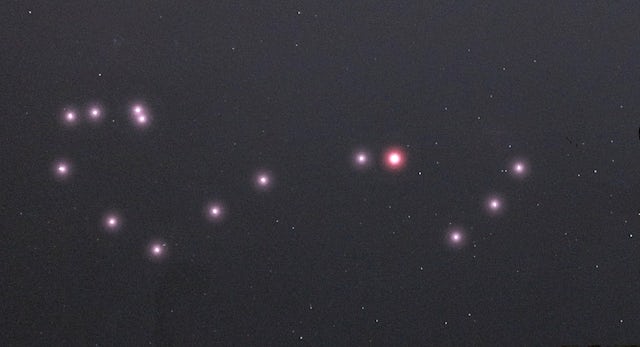
A photo of the constellation Scorpius.

The constellation Scorpius is named for its resemblance to a scorpion. (Image: Nick Lomb)

Scorpius is another spectacular constellation with a curved line of bright stars, with a red star forming the creature’s heart. In January, people who are up at around 3 am can see Scorpius rising in the east, while its quarry Orion is sinking in the west. Alternatively, if you don’t like early mornings you can see the same scene on May evenings after dusk.

The information in this article is from the 2024 Australasian Sky Guide. The guide contains monthly star maps and has much more information to assist with viewing and enjoying the night sky from Australia and New Zealand.The Conversation

This article is republished from The Conversation, the world’s leading publisher of research-based news and analysis. It was written by: Nick Lomb, University of Southern Queensland.

Want to see more stories from Australian Traveller in your Google search results?

  1. Click here to set Australian Traveller as a preferred source.
  2. Tick the box next to "Australian Traveller". That's it.
Nick Lomb
I have had a variety of research directions over my career. During my PhD project on short period variable stars, I developed the theory of least squares frequency analysis for unequally spaced data. This is now a standard method of numerical analysis, called the Lomb or Lomb-Scargle Periodogram, that is used in astronomy and other fields. Later at Sydney Observatory, the focus was on astrometry, that is, the positions and motions of stars and solar system objects. This work culminated in the publication of a star catalogue, of which I was co-author. Then, when the Observatory came under the auspices of the Museum of Applied Arts and Sciences, I became the Museum’s Curator of Astronomy. As such, I planned exhibitions and collected and looked after instruments and other items relating to astronomy. I was also involved with the media and with public education and outreach. On leaving the Observatory and the Museum, my research emphasis became the history of Australian astronomy, with my latest book, with Toner Stevenson, 'Eclipse Chasers', to be released in March 2023. As well, I continue to prepare the annual Australasian Sky Guide for Powerhouse Publishing and maintain my interest in combatting light pollution.
View profile and articles
hero media

Why winter is the best time to be on the New South Wales coast

    Kate Bettes Kate Bettes
    NSW’s beach towns take on a new kind of magic when the cooler months hit.

    Autumn and winter cast a whole new light on the New South Wales coastline. The sun hangs lower, the shadows stretch longer and the air is crisp and fresh. The frenetic summer crowds are gone, and the rhythm slows to the pace of a leisurely winter bush walk through still, damp quiet. From wineries pouring winter reds to the annual whale migration up the ‘humpback highway’, here’s why winter on the New South Wales coast is better.

    Winter on the NSW South Coast

    Winter down south means misty dawns, sipping a flat white on the beach. The thrill of a whale spotting from the headlands and evenings spent slowly savouring Shoalhaven’s wines by the fire.

    Start in Kiama, where waves crash into the famous Blowholes. This natural spectacle is achieved when underground pressure and swell unite, sending sea spray soaring above the basalt cliffs. This means, due to larger waves, you’re even more likely to see an explosive display in winter.

    two people standing in front of kiama blowhole
    See Kiama’s blowholes in full force. (Image: Destination NSW)

    Inland, the Minnamurra Rainforest Walk in Budderoo National Park is all subtropical forest and trilling lyrebird song. Make sure to walk silently along the elevated boardwalks, past winter-swelled creeks and the tangled roots of fig trees. You might just hear one of the musically talented birds mimicking your footsteps.

    Feeling adventurous? Book a session at Illawarra Fly Treetop Adventures for a wobbly walk through the canopy on Australia’s highest zipline.

    Illawarra Fly Treetop Adventures on the new south wales south coast
    Walk among the tallest trees. (Image: Destination NSW)

    Next, it’s time to take the speed down a notch with a drive over to the historic village of Berry. It’s been a beloved stop for generations of Sydneysiders heading south, as has the obligatory stop at its famous doughnut van for crisped, cinnamon goodness. If you’re ready for something a little more chunky, stroll right past the boutiques (okay, go on, just one quick peek) to Milkwood Bakery. Their flaky pastries and all-day breakfasts are best enjoyed under cream-coloured fringed umbrellas.

    Back in Kiama, you’ll also find modern Middle Eastern share plates at Miss Arda, and next-level burgers on The Hungry Monkey‘s extensive menu: an ode to everything pattie-shaped.

    End the day at The Sebel Kiama on the harbour. The apartment-style rooms come with full cooking facilities — a welcome addition for families looking to test out the local produce they picked up along the way. Including, but not limited to, vintages from nearby Crooked River Wines.

    The Sebel Kiama exterior
    Sleep by the harbour.

    Winter on the Mid-North Coast

    A trip up north is a gentle one at this time of year. You’ll still feel that sunshine warming your shoulders, but the lower temperatures make space for rainforest walks, vineyard lunches and long coastal hikes. All without that pesky humidity.

    First stop? It has to be the town of Port Macquarie. Start by marking out a stretch of the nine-kilometre coastal walk you want to tackle (or do the whole thing), which winds from Town Beach to the lighthouse along rugged headlands and quiet beaches. Hot tip: binoculars. Don’t forget them if you want to partake in some close-up sightings of dolphin pods or whales migrating up the ‘humpback highway’.

    Port Macquarie Coastal Walk, winter on the New South Wales coast
    Wander the Port Macquarie Coastal Walk. (Image: Destination NSW)

    Swap sea for canopy at the Sea Acres Rainforest Boardwalk, one of the last remaining pockets of coastal rainforest in the state. The accessible elevated trail passes under climbing ferns and tangled strangler figs, and is alive with scarlet robins, goannas and diamond pythons – if you’re lucky, you might see one slipping through the leaf litter.

    Afterwards, lunch is sorted at Cassegrain Wines, where crisp whites and elegant reds are grown using a blend of French winemaking tradition and Australian innovation. After a tasting, saddle up for a horse ride through the estate.

    port macquarie koala hospital
    Meet Koala Hospital inhabitants at their temporary home. (Image: Destination NSW)

    The beloved Koala Hospital is rebuilding, so meet its furry patients in their temporary bushland abode at Guulabaa – Place of Koala. Here, you can see rehabilitation up close and learn how one of Australia’s most iconic animals is being carefully rewilded and protected.

    Back in town, Whalebone Wharf serves up fine dining with serious views to go with your oysters. Prefer something breezier? Bills Fishhouse + Bar does everything from blue swimmer crab toast to zucchini noodles drizzled in basil and wattleseed pesto. Down by the waterfront, Little Shack slings ceviche, mushroom burgers and fish tacos with casual aplomb.

    At the end of it all, check in to Mercure Centro Port Macquarie, right in the heart of town. From here, everything’s walkable. Just park the car, pop your keys in your pocket, and stroll down to the beach.

    bed at Mercure Centro Port Macquarie
    Check in to Mercure Centro Port Macquarie.

    Winter on the Central Coast

    On the Central Coast, expect to explore oyster farms that sit on estuaries, beaches that stretch empty for miles, and the kind of surprise sightings of whale sprays that can stop a hiker in their tracks.

    The best way to settle into this slower rhythm is with the Bouddi Coastal Walk, an 8.5km trail that dips through rainforest and eroding cliffs. It’s made for unhurried walkers and long-lens photographers.

    Up the coast in Terrigal, it’s prime time to spot humpbacks on the move. Join a cruise or find your own perch — Crackneck Lookout and Norah Head Lighthouse are both local favourites.

    a humpback whale breaching on the central coast
    Spot migrating humpback whales. (Image: Destination NSW)

    Travelling with kids? It would be sacrilege not to visit the Australian Reptile Park. Here, Elvis the saltwater crocodile reigns supreme, and the venomous snake talk somehow manages to be simultaneously terrifying and fascinating.

    If that isn’t enough to wear them out, zip and climb your way through Treetops Adventure Central Coast, a ropes course in the canopy of Ourimbah State Forest. Afterwards, steady your nerves with a garden tasting at Firescreek Botanical Winery, where fruit- and flower-infused wines are served under the trees.

    Switch earth for sea and hop on a boat tour with Broken Bay Pearl Farm. Once you’re out on the water, you’ll learn how pearls are cultivated and have a hands-on lesson in grading and shucking.

    woman holding a pearl at Broken Bay Pearl Farm
    Get a hands-on pearl lesson. (Image: Destination NSW)

    As the day winds down, grab a seat at Yellowtail in Terrigal, which takes seasonal native produce and presents it with Asian flair. Prefer something simple? Award-winning Mount White restaurant Saddles is a quintessential Australian dining destination. Find an impressive breakfast and lunch menu, dedicated to country-style cooking and seasonal produce.

    Stay the night at Pullman Magenta Shores, between the ocean and the lake. There are plenty of ways to relax, with a massage at the day spa, a poolside beanbag and a round or two at the golf course.

    restaurant at Pullman Magenta Shores central coast
    Eat well at Pullman Magenta Shores’ restaurant. (Image: Destination NSW)

    Winter in Wollongong

    Wollongong does contrast pretty well. One moment you’re walking beneath an enormous Buddha, the next you’re ordering soju a few blocks from the surf. It’s a town where skydivers land on beaches, trails lead to paddocks and winter days stretch long and clear beneath the Illawarra cliffs.

    If you’re coming from the north, start by crossing over the Sea Cliff Bridge. Curving dramatically out like a jutting ‘C’ out above the water means you won’t be able to resist pulling over (safely, in designated lookouts) to gaze down at the waves crashing on the cliffs below.

    Just inland is the serenity of the Nan Tien Temple, the largest Buddhist temple in the Southern Hemisphere. You can trace the prayer path, explore the temple gardens and sip delectable Kam Quat Tea in the quiet light at the Dew Drop Inn Tea House.

    monk teaching tai chi at Nan Tien Temple
    Learn about Buddhist practices. (Image: Destination NSW)

    Next, dust off that cowboy hat. It’s time for the Darkes Forest Riding Ranch. Take a guided canter via trail rides among peppermint gums and paddocks. If you’re happier to look at animals than ride them, Symbio Wildlife Park has red pandas dozing in trees, kangaroos that hop up to you and lessons on conservation.

    The brave among you shouldn’t miss Skydive Australia – Wollongong. A free fall over the coast via tandem jumps before tumbling down to the sand is a breath-stopping thrill. Prefer to keep your feet on the ground? Check out the program at Wollongong Art Gallery, which delivers contemporary and Aboriginal exhibitions in the centre of town.

    monkey at Symbio Wildlife Park
    Hang out with the locals at Symbio Wildlife Park.(Image: Destination NSW)

    As evening settles in, nab a table at Baby Face Kitchen. It has an ever-changing set menu, with dishes like hand-picked mud crab with white asparagus and salty brown butter, to sheep’s milk and honey ice cream. For something more casual, Dagwood Bar + Kitchen brings the fun with Korean fried chicken, sake cocktails and weekly all-you-can-eat bao buns.

    Check in to Novotel Wollongong Northbeach, right by the sand. With a beachfront pool and ocean views, it’s an ideal base for whatever pace you choose.

    Novotel Wollongong Northbeach
    Fall asleep listening to the waves.

    Winter on the New South Wales coast starts with a cosy place to stay. Start planning your adventure at all.com.