Driving the Big Lap of Australia – 12 things to know

hero media
Dreaming about driving off into the sunset and doing a big lap of Australia?

Travel writer and photographer Lee Atkinson has just returned from an epic 10-month, 40,000km road trip around the country, and written a book about it (see below). Here are her top 12 road trip travel hacks you need to know before you hit the road.

1. What to drive

You don’t need a 4WD to drive around Australia, but you do need low range gearing to reach some of the most beautiful bits, because the really wild, wondrous places are almost always in out of the way places. If you are towing a van or camper trailer opt for a turbodiesel, because this type of engine works more efficiently than a petrol for towing and diesel is more readily available in remote areas. And go for an automatic, because autos allow you to just stick it in drive and concentrate on other things.
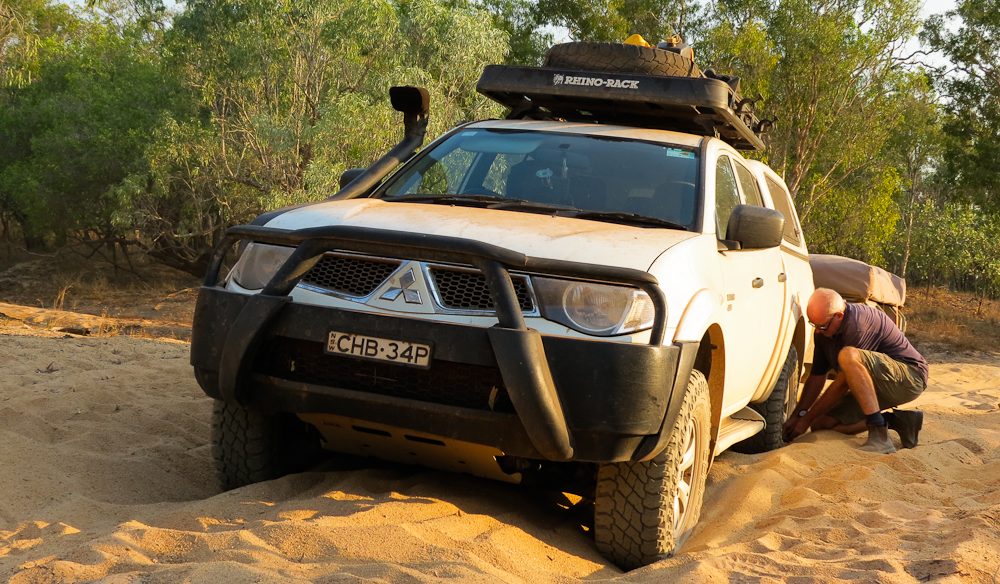
lower tyre pressure
Deep sand means it’s time to lower tyre pressures (photo: Lee Atkinson).

2. To tow or not to tow?

The number one mistake most people make when choosing whether to buy a caravan, motorhome or camper trailer is to think in terms of what it will be like to live in, rather than where they can take it. If you’re planning to spend most of your time on main roads and want to stay in towns or caravan parks, a caravan or motorhome is a great option. But if your idea of a good time is taking the roads less travelled and getting out into national parks and wild places a camper trailer or a roof-top tent is a better choice. Bigger is not always better. There’s an exponential relationship between the size of your caravan or trailer and the extent to which you can get off the beaten track.

3. Before you go…

If you’ve never been outback or off-road before sign up for a 4WD training course. It will teach you how to use the vehicle to its full potential, how to get yourself out of tight spots and, most importantly, how to use recovery gear. Google ‘4WD driver training’. Same goes for towing: not only do you get plenty of time, and traffic-free space, to learn how to manoeuvre and reverse park your vehicle with a caravan or trailer in tow, you’ll also pick up lots of technical and safety information and handy tips. Tow-ed operates courses in most capital cities and regional centres and will lend you a van if you want to learn before you buy.
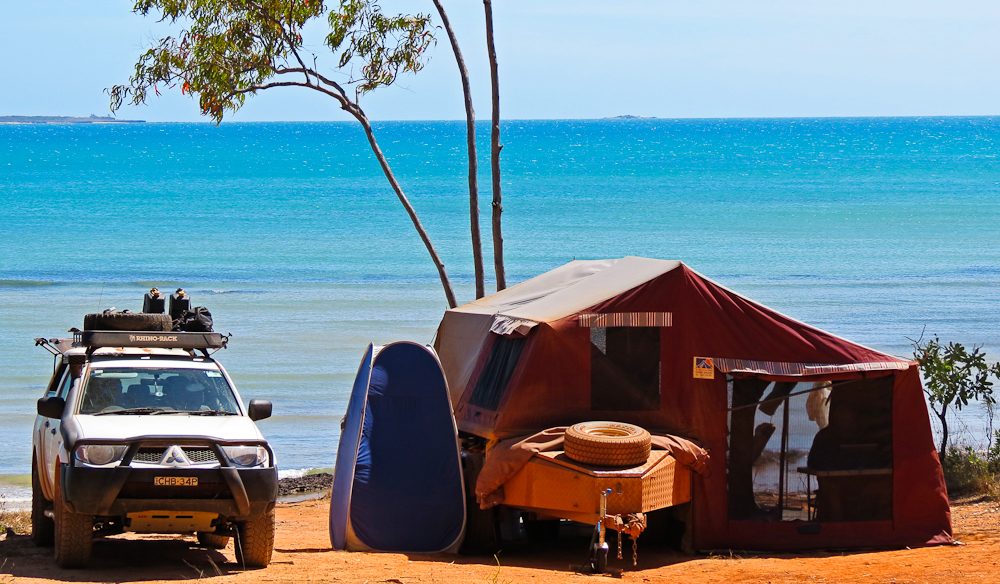
Colourful campsite Rainbow Cliffs Arnhem Land
Colourful campsite, Rainbow Cliffs, Arnhem Land (photo: Lee Atkinson).

4. What tools do you need?

A basic tool kit should include a jack, jacking plate and wheel replacement tools, spare tyre, fire extinguisher, emergency fuel supplies (if heading off the beaten track), engine oil, coolant, jumper leads and spare radiator hoses and fan belts and the tools you’ll need to replace them – check out YouTube for DIY tips and bush mechanic lessons. Don’t even think about leaving home without ultimate get-out-of-jail repair kit: cable ties, gaffa tape and fencing wire – with these you can fix just about anything.

Need tips, more detail or itinerary ideas tailored to you? Ask AT.

AI Prompt

5. Getting out of trouble

Getting stuck is inevitable when you’re travelling off the beaten track. You can spend a fortune on fancy recovery gear but there are five things you really can’t do without: we took a pair of Maxx Trax ramps, which you put under the wheels when you’re bogged in sand or mud. They give the tyres something to grip and, as a rule, will launch you out of trouble easily. We also had a long-handled shovel for digging and a snatch strap for those moments when all else failed – all we needed then was somebody else to come along to pull us out, but it was never used. The best way to not get bogged in the first place is to drop tyre pressures to 20psi or less, so we also carried a quality air compressor and an accurate pressure gauge.

6. Essential kit

Never travel without a first aid kit and always carry extra drinking water. Mobile phone coverage can be non-existent in the outback. Hire (or buy) a satellite phone so you can call for help if needed. Some tourist information centres in remote areas have sat phones you can hire, or visit Satellite Hire or  Rent a Sat Phone.
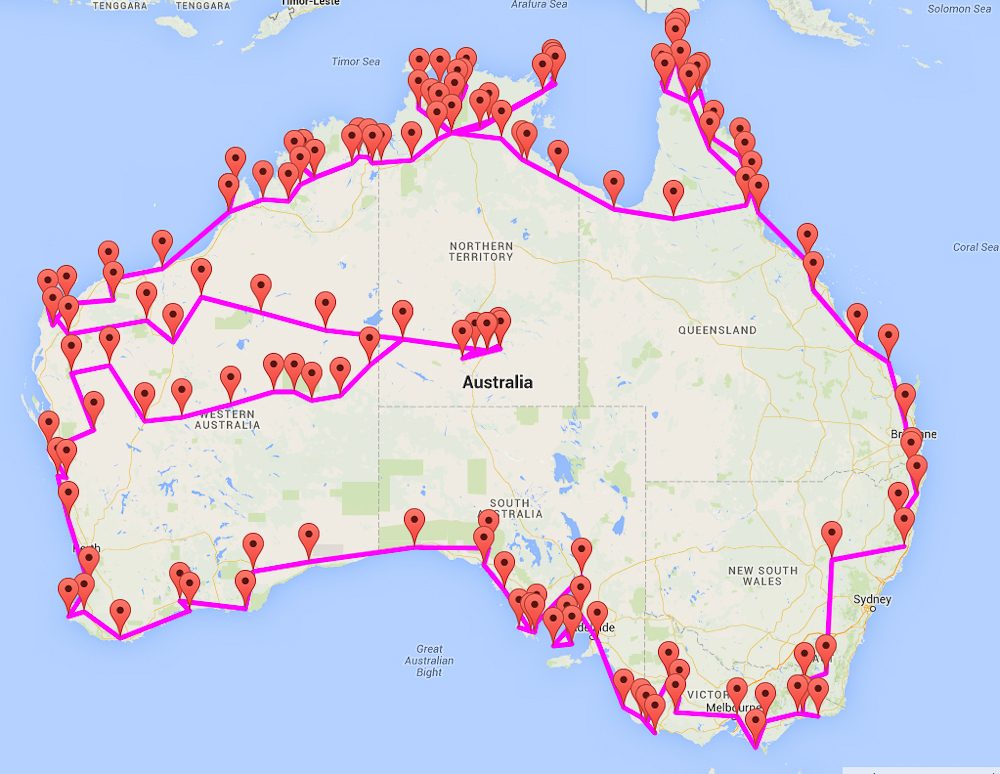
Lee Atkinson's Big Lap map.
Lee Atkinson’s Big Lap map.

7. Map it out

Fighting over which is the right way to go is a major cause of holiday (and marital) breakdown. Don’t rely on the mapping app on your phone – invest in a good GPS. We used Hema Navigator, which features off-road tracks as well as major highways.

8. Keep in touch

These days you can get most of your bills, banks statements etc electronically, which means you can keep the home fires burning relatively easily. Skype is the best thing ever for keeping in touch with friends and family for next to nix. We carried laptops and a 4G mobile wi-fi modem which connects up to 10 devices. Telstra’s the only network that consistently works outside of capital cities.
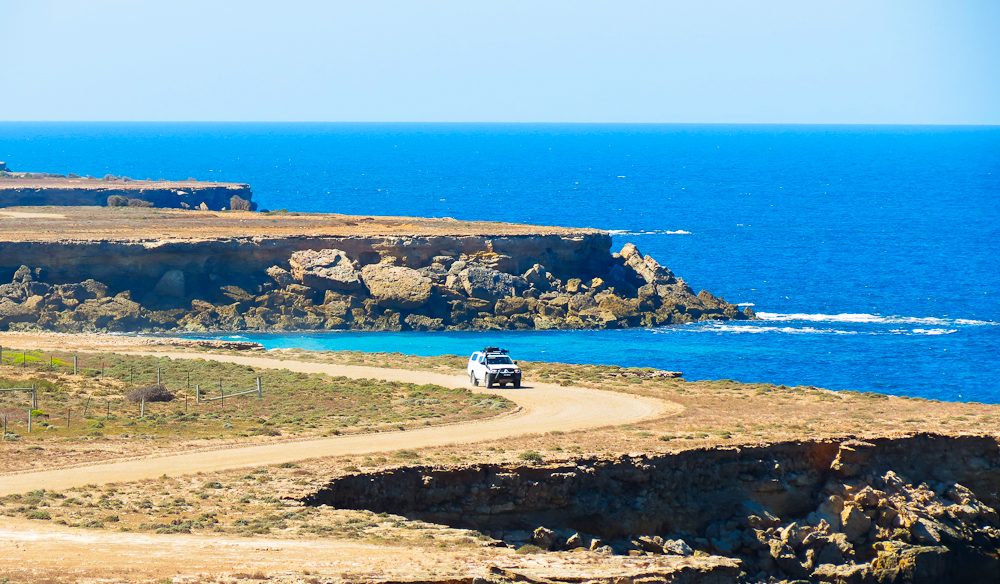
Troubridge Point Yorke Peninsula SA
Coast hugging, Troubridge Point, Yorke Peninsula, SA (photo: Lee Atkinson).

9. Where to go when

Clockwise or anti-clockwise, that’s the million-dollar question when you’re about to head off on the Big Lap. Whether you turn left or right out of your driveway depends on when you go – if it’s summer, head south, if it’s winter, head north or aim for the red centre. The wet season, which cuts roads and closes national parks anywhere north of the Tropic of Capricorn, can be anytime from November through to May, although it (usually) really only starts to rain in mid to late December and can be all over by April.
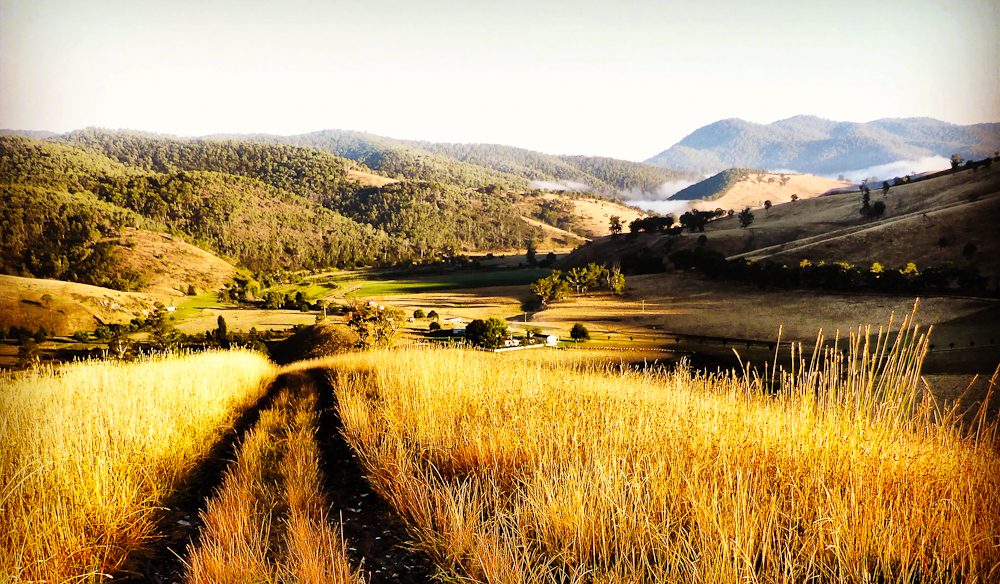
The back way, Gippsland, (photo: Lee Atkinson),

Weekly travel news, experiences
insider tips, offers, and more.

10. How long will it take?

How long have you got? Know that however long you go for, it won’t be enough – Australia’s a big place and you could spend a lifetime and still not see it all. On the other hand, you’d be amazed at how far you can go in just four weeks. We spent 42 weeks on the road, and didn’t go where most do go, but did go where many people don’t.

11. How much will it cost?

Everyone’s trip is different, depending on what you drive, where you go, where you stay and what you eat and drink. We were in a 4WD and towing an off-road camper trailer. In terms of day-to-day expenses we averaged just under $150 a day, including fuel, camping fees and the occasional night in a pub if the weather was foul, food and alcohol – we probably could have got that down a little if my partner was a better fisherman, and if I’d chosen cheaper wine, but hey, life’s too short!

12. Can I take my dog?

Many caravan parks will accept well-behaved pets on a leash, but always check before you book rather than on arrival. Pets are not allowed in national parks, even for day visits or picnics. If you want to bush camp with pets, choose state forests instead.

You can read all about Lee’s epic road trip in her book, The Big Lap.
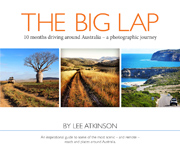
The Big Lap by Lee Atkinson

The Big Lap by Lee Atkinson.


“We took the road less travelled whenever we could, camping in national parks and other wild places where few other travellers go," says Atkinson. “We found some truly amazing places and saw some fantastic things, and this book is the result, a showcase of some of the most scenic spots in Australia." Featuring hundreds of beautiful images, the book is the pictorial diary of her journey with detailed captions telling the stories behind the images. The Big Lap costs $35, (including postage), from ozyroadtripper.com.au

Want to see more stories from Australian Traveller in your Google search results?

  1. Click here to set Australian Traveller as a preferred source.
  2. Tick the box next to "Australian Traveller". That's it.
hero media

Farm fresh produce to a trail of lights: the ultimate guide to Mildura

    Rachel Lay Rachel Lay
    The charm of Mildura is hidden in plain sight along the Sturt Highway. The capital of Tropical North Victoria is in a league of its own.

    From the moment you arrive in Mildura, the warm air and palm trees invite you to slow down. While most Australians might drive right past it, Mildura is full of surprises. Here you’ll spend one day witnessing over 50,000 years of First Nations history in a UNESCO-listed National Park, and the next dining in a hatted restaurant after wandering through 12,500 fireflies as the outback sunset bursts to life above. From roadside fruit stalls and family-run wineries to houseboats and galleries, it’s time to explore Mildura.

    Feast Street, at the heart of Langtree Avenue in Mildura.
    Taste, wander and be surprised in Mildura.

    Taste Mildura’s produce

    It makes sense to start your trip by addressing the most important question: where to eat. In the beating heart of Australia’s food bowl, sample the local produce directly from the source. And then, of course, experience it through the menu of a hatted chef. Or sandwiched between pillowy slices of Nonna’s ciabatta.

    Rows of orchards and olive groves invite you to spend the day traipsing from farm to farm. Taste olives propagated from Calabrian trees brought over in the 40s, oranges picked right from the tree and squeezed into juice and spoons full of honey. Bring the holiday back to your kitchen by stocking your pantry at roadside produce stalls, or calling into the ‘silver shed’ (Sunraysia’s gourmand Mecca).

    Thanks to the warm, balmy air and fertile soils, the wineries dotted along these hills produce award-winning local wines. Like Chalmers, a family-run, innovative winery dedicated to making their wines as sustainable as possible. And picturesque Trentham Estate offers views of the snaking Murray River as you sample their vintages.

    Venture beyond the gnarled shadows of olive groves and fragrant rows of blossoming fruit trees and you’ll find an otherworldly side to Mildura. With Discover Mildura as your guide, visit Murray River Salt’s Mars-like stacks. The naturally pink salt is formed from an ancient inland sea and evaporated entirely by the sun to create one of the region’s most iconic exports.

    Start your day with just-squeezed sunshine.

    Hatted dining & Italian history

    Mildura is home to a proud community of Calabrians and Sicilians. This, paired with the exceptional local produce, means that you can find paninos on par with those in Italy. The Italian is a Paninoteca serving up made-to-order, hefty, authentic Sicilian paninos. Nonna Rosa’s pork meatballs, slowly cooked in tomato ragu and served in a crusty, fluffy roll topped with gratings of Grana Padano cheese and salsa verde, will call you back to Mildura for the rest of your days.

    To find hatted dining in Mildura, simply follow the staircase down into the basement of the historic Mildura Grand Hotel to find Stefano’s. Following the muscle memory and instinct of his Italian roots, he delivers on the principle of ‘cucina povera’. That is, the Italian cooking ideology that turns simple, local ingredients into magic.

    Things to do in Mildura include dining at the acclaimed Stefano’s, where simple local ingredients are transformed into Italian culinary magic beneath the historic Grand Hotel.
    Bite into Mildura’s Italian heritage.

    Discover a thriving culture scene

    The city is alive with culture. Whether it’s painted on the town’s walls, told in ancient yarns, or waiting for you in a gallery.

    The Mildura Arts Centre was Australia’s first regional art gallery. Behind the walls of Rio Vista Historic House, you’ll find a lineup of ever-changing exhibitions. The gallery’s wall space pays tribute to the art and songlines of local First Nations People, the region’s awe-inspiring landscapes and more. Outside, on the gallery’s lawn, find 12 contemporary sculptures in the Sculpture Park.

    Mildura’s streetscapes are a punch of colour. Swirling strokes of paint blend the winding artery of the Murray River, red dirt and local characters into a story you can see with your own eyes, thanks to the Mildura City Heart’s Mural Art Project. Pick up a copy of the Murals of Mildura guide from the Visitor Information Centre.

    Follow the border of NSW and Victoria on a map and you’ll see it hugs the curves of a tiny island on the Murray. That’s Lock Island, where, as the sun and moon trade places, the island comes alive as darkness falls. The island is dotted with 12,500 firefly lights that lead you on a meandering path through the outback sunset. The installation is known as Trail of Lights and was created by the same visionary who dreamt up Field of Light at Uluṟu, Bruce Munro.

    Things to do in Mildura include exploring its rich cultural scene. From vibrant street art and ancient stories to exhibitions at the Mildura Arts Centre, Australia’s first regional gallery.
    Find culture around every corner.

    Wonder at ancient landscapes

    The landscapes of Mildura feel almost transcendental. The skyline bursts to life with reds, pinks, and deep, sparkly night skies.

    The nature will leave you in awe. See hues of pink water changing with the weather at Pink Lakes inside Victoria’s largest national park, Murray Sunset National Oark. Cast a line into Ouyen Lake. Watch the sunset against 70-metre tall red cliffs that reflect the setting sun. Or get the heart racing and sandboard down the Perry Sandhills dunes, formed 40,000 years ago at the end of an ice age.

    Just don’t leave without following the twists and turns of the Murray. Stroll or ride along the Shared River Front Path, or jump onboard a boat for a scenic ride.

    Your itinerary will be incomplete without a visit to UNESCO World Heritage-listed Mungo National Park. Head out with an Indigenous ranger to witness ancient campsites and footprints, before standing in awe of ancient civilisation near the discovery site of Mungo Man—Australia’s oldest human skeleton at 42,000 years old.

    Mungo National Park at night is a vast, silent landscape where ancient dunes glow under moonlight and stars blanket the sky in breathtaking clarity.
    Walk in the footsteps of ancient civilisation.

    Meet your home away from home

    On equal par with planning your meals and adventures, is finding the perfect place to relax at the end of each day.

    Sleep inside a Palm Springs postcard at Kar-Rama. A sleek boutique hotel complete with a butterfly shaped, sun-soaked pool. Here you’re staying right in the heart of Mildura but you’ll feel worlds away. Or if you really wish to connect with nature, a night glamping under the stars at Outback Almonds will have you spellbound.

    When in Mildura it’s only right to stay on one of the Murray River’s iconic houseboats. Wake up each day to the calm waters of the Murray lapping outside your window. Enjoy days full of river swims, fishing and exploring. All boats are solar-powered and can be self-skippered or moored along the river.

    A solar-powered houseboat on the Murray River in Mildura.
    Stay and play on the Murray in a solar houseboat.

    Start planning the perfect getaway at mildura.com.

    12 Things You Need to Know for Driving Around Australia